Building an inground pool represents one of the most significant investments homeowners make in their properties. In Pennsylvania, where seasonal weather patterns and specific building codes create unique challenges, choosing the right pool contractor becomes even more critical. Unfortunately, many homeowners rush into agreements with the first builder they contact, only to encounter delays, budget overruns, or substandard workmanship that haunts them for years.
The difference between a dream backyard oasis and a construction nightmare often comes down to avoiding common hiring mistakes. Whether you’re searching for custom inground pool construction in Philadelphia’s suburbs or residential pool installation services in Pittsburgh, understanding these pitfalls protects both your investment and your peace of mind. This guide walks you through the seven most damaging mistakes Pennsylvania homeowners make when selecting pool builders—and how to avoid them.

Key Takeaways
- Always verify state licensing and insurance before signing any pool construction contract
- Request and check at least three references from recent inground pool projects
- Obtain detailed written estimates from multiple local pool installation experts
- Confirm the builder handles all necessary permits and inspections in Pennsylvania
- Review online ratings and pool builder reviews Pennsylvania homeowners have posted
- Never pay the full amount upfront—standard deposits range from 10-30%
Mistake #1: Failing to Verify Licensing and Credentials
Why Licensing Matters in Pennsylvania
Pennsylvania requires specific contractor licenses for pool construction, and these requirements vary by municipality. Professional pool contractors PA must hold valid credentials that demonstrate they’ve met state and local standards for construction knowledge, safety protocols, and business practices.
What to verify:
- State contractor registration through the Pennsylvania Attorney General’s Office
- Local business licenses in your municipality
- Specialty certifications from organizations like the Pool & Hot Tub Alliance (PHTA)
- Worker’s compensation coverage
- General liability insurance with minimum coverage of $1 million
The Real Cost of Unlicensed Contractors
Hiring unlicensed builders might seem like a way to save money, but it exposes you to enormous risks. If an unlicensed contractor damages your property, injures a worker, or abandons the project, you have limited legal recourse. Moreover, many municipalities won’t issue permits to unlicensed contractors, leaving you with an illegal pool that could trigger fines or forced removal.
Do:
- Request copies of all licenses and insurance certificates
- Call the issuing agencies to verify authenticity
- Confirm coverage is current and adequate for your project size
Don’t:
- Accept verbal assurances about licensing
- Hire contractors who claim licenses “aren’t necessary” for your area
- Skip verification because the builder seems professional
Mistake #2: Neglecting to Research the Company’s Track Record
Beyond the Sales Pitch
Best inground pool contractors PA earn their reputation through years of consistent quality work. Sales presentations and glossy brochures tell only part of the story. Deep research reveals whether a company delivers on its promises.
When evaluating inground pool companies near me, investigate multiple information sources. The Better Business Bureau provides complaint histories and resolution patterns. Online review platforms like Google, Yelp, and HomeAdvisor show customer experiences, though you should read both positive and negative reviews critically.
Reference Checks That Actually Work
Most builders provide references, but smart homeowners go deeper. Request contact information for at least five recent projects, then ask specific questions:
- Did the project finish on time and within budget?
- How did the builder handle unexpected issues or change orders?
- Would you hire them again?
- How was communication throughout the process?
- Are you satisfied with the pool’s performance after multiple seasons?
If possible, visit completed pools to see the builder’s work firsthand. Pay attention to finishing details, equipment installation quality, and overall craftsmanship. For trusted options, explore our guide on how to find the best pool builders in Pennsylvania.
Mistake #3: Accepting Vague or Incomplete Contracts
Essential Contract Components
A professional contract for custom inground pool construction protects both parties by establishing clear expectations. Incomplete agreements create opportunities for disputes, surprise costs, and legal battles.
Comparison: Adequate vs. Inadequate Contracts
| Element | Professional Contract | Inadequate Contract |
|---|---|---|
| Project scope | Detailed specifications for every component | Vague descriptions like “standard pool” |
| Payment schedule | Tied to completion milestones | Large upfront payment demanded |
| Timeline | Specific start and completion dates with weather allowances | “We’ll finish when we finish” |
| Materials | Brand names, models, and specifications | Generic categories without specifics |
| Warranty coverage | Separate warranties for structure, equipment, and workmanship | Single vague warranty or none |
| Change order process | Written procedure with pricing methodology | Verbal agreements only |
Red Flags in Pool Contracts
Licensed pool builders Pennsylvania should provide comprehensive written agreements before any work begins. Walk away from contractors who pressure you to sign incomplete documents or handshake deals. If the builder claims detailed contracts “slow things down,” you’re dealing with someone who prioritizes their convenience over your protection. Be sure you understand key questions to ask before hiring to ensure clarity from day one.
Mistake #4: Choosing Based Solely on Price
The True Cost of the Lowest Bid
Price matters, but the cheapest estimate often signals future problems. Unusually low bids might indicate:
- Unlicensed or underinsured contractors cutting costs illegally
- Inferior materials that fail prematurely
- Inexperienced crews who lack proper training
- Hidden fees that emerge during construction
- Financial instability that could lead to abandoned projects
Value-Based Decision Making
Compare proposals by examining what each includes. If one estimate seems significantly lower, identify what’s missing or different. Perhaps the low bidder plans to use a thinner concrete shell, lower-grade equipment, or simplified plumbing systems.
Pros and Cons: Budget vs. Premium Pool Builders
Budget Builders
- Pros: Lower initial cost, basic functionality, faster project approval
- Cons: Limited customization, shorter warranties, potential quality compromises, less experienced staff
Premium Builders
- Pros: Superior materials, extensive warranties, proven track record, comprehensive service
- Cons: Higher upfront investment, longer wait times for scheduling
If you need a basic rectangular pool with standard features and have budget constraints, a mid-range contractor might suffice. If you want custom shapes, advanced features, or cutting-edge technology, investing in experienced residential pool installation services pays dividends through better performance and longevity. Use our comprehensive guide to swimming pool installation costs in PA to set realistic expectations.
Mistake #5: Overlooking Permit and Zoning Requirements
Pennsylvania’s Complex Regulatory Landscape
Pool construction in Pennsylvania requires navigating multiple regulatory layers. State regulations, county ordinances, and municipal codes all impose different requirements. Professional contractors understand these complexities and handle the permit process efficiently.
Step-by-Step: The Pennsylvania Pool Permit Process
- Pre-application research – Verify your property meets setback requirements (typically 10-15 feet from property lines)
- Design approval – Submit detailed plans showing pool location, dimensions, and equipment placement
- Building permit application – File with your local municipality’s building department
- Utility clearance – Coordinate with utility companies to mark underground lines
- Inspections scheduling – Arrange required inspections at excavation, plumbing, electrical, and final stages
- Certificate of occupancy – Obtain final approval before using the pool
Reputable local pool installation experts handle this entire process, ensuring compliance and preventing costly violations. Learn more about Pennsylvania pool permit and zoning requirements.
The Danger of Permit Shortcuts
Some contractors offer to skip permits to “save time and money.” This creates serious problems:
- Fines ranging from hundreds to thousands of dollars
- Forced pool removal in extreme cases
- Voided homeowner’s insurance coverage
- Difficulty selling your home due to unpermitted improvements
- Safety hazards from uninspected construction
For a full walkthrough of what to expect, see our detailed overview of the custom pool building process in Pennsylvania.
Mistake #6: Ignoring the Importance of Insurance Coverage
Why Insurance Protects Your Investment
Even the best inground pool contractors PA occasionally face accidents, property damage, or worker injuries. Comprehensive insurance coverage prevents these incidents from becoming your financial responsibility.
Required Insurance Types:
General Liability Insurance
- Covers property damage and bodily injury to third parties
- Minimum recommended coverage: $1 million
- Protects you if construction damages your home, landscaping, or utilities
Worker’s Compensation
- Covers medical expenses and lost wages for injured workers
- Required by Pennsylvania law for companies with employees
- Without it, injured workers might sue you directly
Commercial Auto Insurance
- Covers vehicles used for business purposes
- Protects against accidents involving company trucks or equipment
Verification Process
Don’t just ask whether the contractor has insurance—request certificate of insurance (COI) documents. Contact the insurance company directly to confirm:
- Coverage is currently active
- Policy limits meet your project’s needs
- Your property address is listed as the work location
This is one of the essential topics covered in our guide on choosing the right pool builder in Pennsylvania.
Mistake #7: Failing to Understand Warranty Coverage
Types of Pool Warranties
Professional pool contractors PA offer multiple warranty categories, each covering different components and timeframes:
Structural Warranty
- Covers the pool shell and main structure
- Typically ranges from 10-25 years for concrete pools
- Should transfer to future homeowners
Equipment Warranty
- Covers pumps, filters, heaters, and automation systems
- Usually 1-3 years for labor, longer for parts
- Often provided by equipment manufacturers
Workmanship Warranty
- Covers installation quality and contractor errors
- Typically 1-2 years
- Ensures the builder stands behind their work
Case Study: The Hidden Warranty Gap
A homeowner in suburban Philadelphia hired a contractor offering a “lifetime warranty” without reading the fine print. Two years later, cracks appeared in the pool shell. The warranty covered materials but excluded labor costs for repairs—leaving the homeowner facing $15,000 in unexpected expenses. The lesson: understand not just warranty duration, but what’s actually covered and who pays for repairs.
Do:
- Get all warranty terms in writing before signing contracts
- Understand exclusions and limitations
- Ask about the process for filing warranty claims
- Verify the company’s longevity—warranties mean nothing if the business closes
Don’t:
- Assume “warranty” means complete coverage
- Accept verbal warranty promises
- Ignore maintenance requirements that could void coverage
Evaluating Communication and Professionalism
Why Responsiveness Matters
How a builder communicates during the sales process predicts how they’ll handle your project. Professional pool contractors PA respond promptly to inquiries, answer questions thoroughly, and provide clear explanations of technical details.
Red flags include:
- Days of silence after initial contact
- Vague answers to specific questions
- Pressure tactics demanding immediate decisions
- Reluctance to provide written information
If you struggle to get answers before signing a contract, expect even worse communication during construction. Strong builders maintain regular contact, provide progress updates, and address concerns quickly. This aligns with what top-rated builders do, as outlined in our piece on what to look for in a PA pool contractor.
Understanding Timeline Expectations
Realistic Construction Schedules
Pennsylvania’s climate limits pool construction to roughly April through October. Most inground pools require 8–12 weeks from excavation to completion, though complex custom designs might extend to 16 weeks.
Factors affecting timeline:
- Weather delays (rain halts concrete work)
- Permit processing times (2–6 weeks in most PA municipalities)
- Material availability for custom features
- Contractor’s current project backlog
If a builder promises completion in just 3–4 weeks, they’re either oversimplifying the process or planning to cut corners. Conversely, timelines exceeding 20 weeks for standard pools might indicate poor project management. For accurate benchmarks, refer to our breakdown of the typical inground pool construction timeline in PA.
The Value of Local Expertise
Why Local Pool Installation Experts Excel
Contractors familiar with Pennsylvania’s specific challenges provide advantages national chains can’t match:
- Knowledge of local soil conditions (clay-heavy soils in southeastern PA require different approaches than rocky terrain in the Poconos)
- Relationships with municipal inspectors that smooth permit processes
- Understanding of Pennsylvania’s freeze-thaw cycles and proper winterization requirements
- Established supplier networks for faster material delivery
- Nearby location for warranty service and emergency repairs
When comparing pool builder reviews Pennsylvania homeowners post online, prioritize feedback from your specific region. A contractor who excels in Erie might struggle with Philadelphia’s different regulations and conditions. Proper seasonal care, including Pennsylvania pool winterization tips, is a hallmark of true local expertise.
Quick Answers – Frequently Asked Questions
Q: How much should I expect to pay for an inground pool in Pennsylvania?
A: Inground pools in Pennsylvania typically cost $40,000–$100,000 depending on size, materials, and features. Basic vinyl pools start around $35,000, while custom concrete designs with premium features can exceed $150,000. See our full swimming pool installation cost guide for PA for details.
Q: Do I need a permit to build a pool in Pennsylvania?
A: Yes, virtually all Pennsylvania municipalities require building permits for inground pools. Your contractor should handle the permit application process as part of their services. Learn more about essential permits you need for pool construction.
Q: What’s the best time of year to hire a pool builder in PA?
A: Winter and early spring (January–March) offer the best selection and scheduling flexibility. Contractors are less busy, and you’ll secure prime summer construction slots.
Q: How long do inground pools last in Pennsylvania?
A: With proper maintenance, concrete pools last 25–50+ years, fiberglass pools 25–40 years, and vinyl liner pools 15–25 years (though liners require replacement every 7–10 years).
Q: Should I hire a pool builder who also offers maintenance services?
A: Companies offering both construction and maintenance demonstrate long-term commitment. However, the quality of construction matters most—you can always hire separate maintenance providers.
Q: What questions should I ask during the initial consultation?
A: Ask about licensing, insurance, experience with your preferred pool type, project timeline, payment schedule, warranty coverage, and how they handle unexpected issues or change orders. Our list of key questions to ask before hiring can help.
Q: Can I install a pool myself to save money?
A: DIY pool installation is technically possible but highly discouraged. The complexity of plumbing, electrical work, and structural engineering—combined with permit requirements—makes professional installation worthwhile for safety and quality. Read our DIY swimming pool construction guide to understand the challenges.
Q: What happens if my pool builder goes out of business during construction?
A: This highlights the importance of reasonable payment schedules. Never pay more than 10–30% upfront. Consider requiring payment bonds for large projects, which provide financial protection if the contractor defaults.
Q: How do I verify a contractor’s references aren’t fake?
A: Visit completed projects in person when possible. Search for the reference’s address online to verify it’s a real property. Ask detailed questions that generic fake references couldn’t answer convincingly.
Q: What’s the difference between a pool builder and a pool installer?
A: The terms are often used interchangeably. However, “pool builder” might imply more comprehensive services including design and engineering, while “installer” could focus purely on construction execution.
Glossary of Terms
Setback Requirements: Local zoning regulations that dictate minimum distances between pools and property lines, structures, or utilities. Pennsylvania setbacks typically range from 10–20 feet depending on municipality. More on this in our permits and regulations guide.
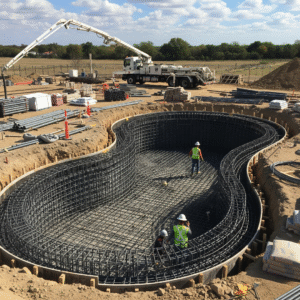
Gunite Pool: A type of concrete pool construction where a cement mixture is sprayed through a high-pressure hose onto a steel rebar framework. Gunite offers exceptional strength and design flexibility for custom shapes. It’s a popular choice in Pennsylvania due to its durability in freeze-thaw cycles—learn more in our custom pool building process overview.
Change Order: A written agreement modifying the original contract terms, typically involving additional work, material substitutions, or design changes. Legitimate change orders specify new costs and timeline adjustments.
Winterization: The process of preparing a pool for Pennsylvania’s freezing temperatures by draining water lines, adding antifreeze, and covering the pool. Proper winterization prevents expensive freeze damage to plumbing and equipment. Get step-by-step guidance in our Pennsylvania pool winterization tips.
Conclusion
The excitement of planning a new inground pool shouldn’t overshadow the critical importance of choosing the right contractor. By avoiding these seven common mistakes—verifying credentials, researching track records, demanding comprehensive contracts, looking beyond price, ensuring proper permits, confirming insurance coverage, and understanding warranties—you protect yourself from the frustration and financial losses that plague many pool projects.
The best inground pool contractors PA offer more than construction services. They provide expertise, transparency, and peace of mind throughout what should be an exciting home improvement journey. Take the time to vet candidates thoroughly, ask difficult questions, and trust your instincts when something feels off.
Ready to start your pool project the right way? Begin by creating a list of licensed pool builders in Pennsylvania, schedule consultations with at least three candidates, and use the guidelines in this article to evaluate each one systematically. Your dream pool awaits—built right, by professionals who stand behind their work.