Is your swimming pool fighting you? You meticulously test the water, add your chemicals, and yet it stays stubbornly cloudy. Maybe your skin feels itchy after a swim, or you notice a gritty, white film building up on your tile line.
These are classic signs that your pool’s chemistry is out of balance. While most homeowners point the finger at pH, the real culprit is often its overlooked (and very stubborn) relative: Total Alkalinity.
High alkalinity is one of the most common and frustrating problems pool owners face. It can make your pH impossible to control, render your chlorine ineffective, and even damage your pool equipment.
Don’t worry. This isn’t a chemistry test you have to fail. This guide will walk you through exactly what Total Alkalinity is, why it matters so much, and the step-by-step process to lower pool alkalinity the right way. You’ll learn how to stop “chasing numbers” and finally achieve the crystal-clear, comfortable water you deserve.
What is Total Alkalinity (And Why Does It Get So High)?
Let’s clear this up first: Total Alkalinity (TA) is not the same as pH.
Think of pH as your pool’s mood. It can swing up (too basic) or down (too acidic) very quickly.
Think of Total Alkalinity as your pool’s emotional stability.
TA is the measure of all dissolved alkaline substances (like carbonates, bicarbonates, and hydroxides) in the water. These substances act as a buffer, or an “anchor,” for your pH.
- Good TA (80-120 ppm): Your pH is stable. It stays where you want it.
- Low TA (Below 80 ppm): Your pH is erratic. A little rain or a few swimmers can cause it to swing wildly. This is called “pH bounce.”
- High TA (Above 120 ppm): Your pH is stubborn. It “locks” in place and refuses to budge, even when you add chemicals to lower it. This is “pH lock.”
Why Is My Alkalinity So High?
In many parts of Pennsylvania, the municipal or well water used to fill your pool may naturally have high alkalinity. But the most common reason is human error.
The main chemical used to raise pH is soda ash. The main chemical used to raise alkalinity is sodium bicarbonate (baking soda). Many pool owners, especially new ones, often confuse the two or add too much “alkalinity increaser” trying to fix a pH problem, accidentally sending their TA levels soaring.
The Problems Caused by High Pool Alkalinity
So, the water’s a bit “stable.” What’s the big deal? A high TA level is the starting point for a cascade of expensive and annoying problems.
Problem 1: Stubbornly Cloudy Water
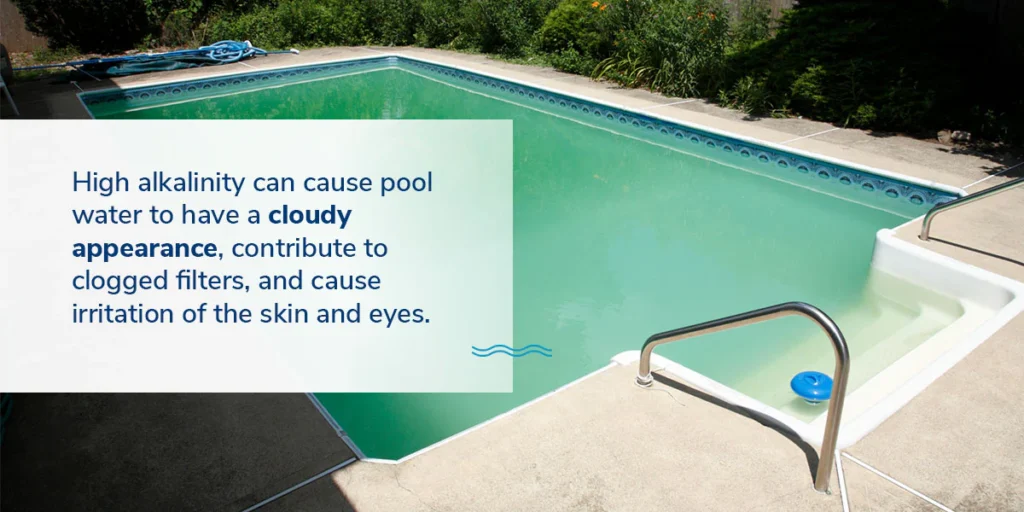
High alkalinity is a major contributor to high pH. When your pH and alkalinity are both high, the calcium in your water can no longer stay dissolved. It precipitates out of the solution and forms calcium carbonate, also known as “scale.”
This scale is what makes your water look milky or cloudy. It’s also the crusty, white deposit that builds up on your pool’s tile, plaster, and inside your filter and heater. This scale buildup can clog pipes and severely shorten the life of your expensive pool equipment.
Problem 2: pH Lock
This is the most frustrating part of high TA. You test your water and see the pH is way too high (say, 8.0). You add “pH down” (an acid) to lower it. You test again hours later, and… nothing. The pH is still 8.0.
The massive buffer of alkalinity is neutralizing the acid as fast as you add it, making it impossible to adjust your pH.
Problem 3: Poor Chlorine Performance
This is the big one. Your chlorine’s effectiveness is directly tied to your pH level.
When your pH is too high (which high TA encourages), your chlorine essentially goes on vacation. It becomes lazy and inefficient. You are forced to use more and more chlorine (which costs more money) just to get the same level of sanitation. This creates a vicious cycle of balancing pool chemicals that never seems to end, all while bacteria and algae get a chance to gain a foothold.
Problem 4: Skin and Eye Irritation
That “pool smell” and the red, itchy eyes? That’s not just from chlorine. It’s often from chloramines—a byproduct of chlorine trying to work in high-pH water. The uncomfortable, alkaline water itself can also strip natural oils from your skin and hair, leaving you feeling dry and itchy.
What is the Ideal Total Alkalinity Level for Your Pool?
Before you can fix the problem, you need a target.
The ideal range for Total Alkalinity is 80 to 120 ppm (parts per million).
Most pool experts, including our team at Poseidon, recommend keeping it right around 100 ppm. According to the CDC, this is the sweet spot that provides enough buffer to keep your pH stable without causing pH lock or scaling.
This range is perfect for most pool types, from a custom gunite pool in Bucks County to a vinyl-liner pool in Montgomery County.
Quick-View: Ideal Pool Chemistry
| Parameter | Ideal Range |
| Total Alkalinity (TA) | 80 – 120 ppm |
| pH | 7.4 – 7.6 |
| Free Chlorine | 1.0 – 3.0 ppm |
| Calcium Hardness | 200 – 400 ppm |
First Step: How to Accurately Test Your Alkalinity
You can’t fix what you don’t measure. Guessing is the fastest way to waste money on chemicals.
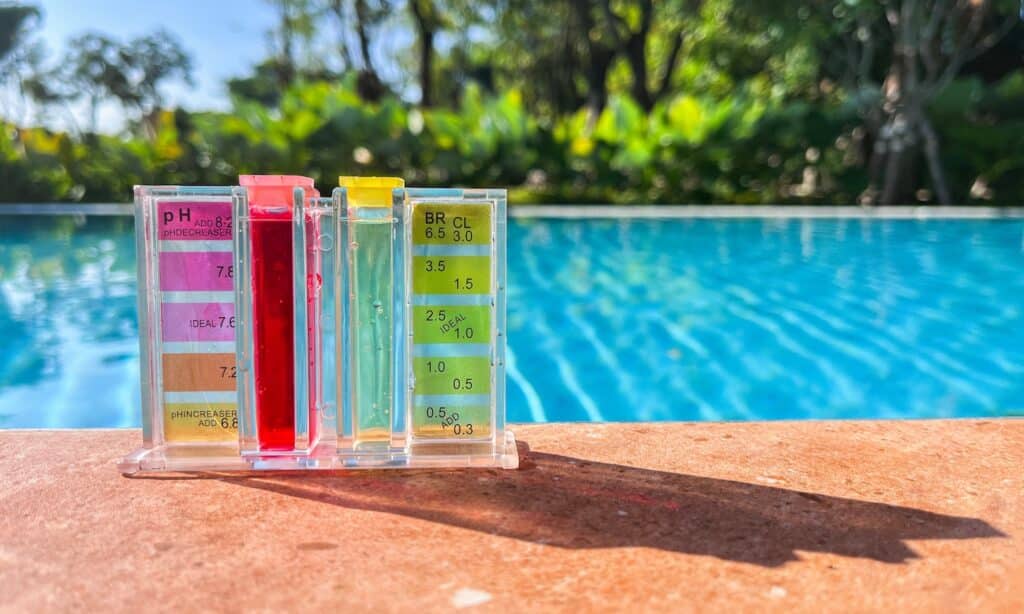
- Test Strips: These are quick and easy. Dip the strip, wait 15 seconds, and match the colors. They are good for a quick check, but their accuracy can be affected by sunlight or humidity.
- Liquid Test Kits (DPD Kits): This is the method most professionals use. You add drops of a reagent to a water sample until the color changes. This method is much more precise.
- Digital Testers: These are the most accurate (and most expensive) option, giving you a precise digital readout.
Pro Tip: Always test for alkalinity before you test for pH. Since TA stabilizes pH, you must balance your alkalinity first. Test your water weekly, and also after any major event, like a big pool party or a heavy Pennsylvania rainstorm, which can both impact your water chemistry, as noted by sources like Penn State Extension.
A Step-by-Step Guide to Lower Pool Alkalinity
Okay, you’ve tested your water and your TA is high—say, 180 ppm. It’s time to bring it down.
The only way to lower pool alkalinity is by adding an acid to the water. The two most common options are muriatic acid (a liquid) and sodium bisulfate (a granular dry acid).
Important: This process will also cause your pH to drop, often significantly. This is normal. The secret is in the second phase of the process: raising the pH without raising the alkalinity.
What You’ll Need
- Safety Goggles
- Acid-resistant gloves
- Muriatic acid OR sodium bisulfate (dry acid)
- A clean 5-gallon bucket
- Your pool test kit
Step 1: Safety First
You are handling acid. This is not the time to be careless. Wear your goggles and gloves. This aspect of pool chemical safety is critical. If you splash any on your skin, rinse it off immediately with fresh water.
The Golden Rule: Always Add Acid to Water (AAA). NEVER add water to acid, as it can cause a violent, dangerous reaction.
Step 2: Calculate Your Dose
Do not “eyeball” it. Read the manufacturer’s instructions on the acid bottle or bag. It will tell you exactly how much to add to lower the TA in your specific pool volume (in gallons).
If you’re unsure, it is always better to add less than you think you need. You can always add more later. You can’t take it out.
Step 3: Add the Acid (The Right Way)
Turn your pool pump on so the water is circulating.
- If using Muriatic Acid: Fill your 5-gallon bucket 3/4 full with pool water. Then, carefully add the pre-measured amount of muriatic acid to the bucket of water.
- If using Dry Acid: Fill the bucket 3/4 full with pool water. Then, add the dry acid to the bucket and stir with a non-metal stick until it’s dissolved.
Now, walk around the deep end of your pool and pour the diluted mixture slowly into the water. Pouring it into the deep end helps it mix without damaging your pool’s surface.
Step 4: Circulate and Wait
Let the pump run for at least 4 to 6 hours to fully circulate the acid. After this, test your TA and your pH.
You will notice both are now lower. For example, your TA might be 130 ppm (down from 180) and your pH might be 7.0 (down from 7.8). This is exactly what we want.
Step 5: The Aeration Secret
Now we need to fix the low pH. But wait—if you add a pH increaser (soda ash), won’t that raise the alkalinity, too? Yes.
This is the step everyone misses. The secret to raising your pH without raising your alkalinity is aeration.
Aeration means forcing air into the water. This process releases carbon dioxide from the water, which causes the pH to rise with almost no effect on the TA.
How do you aerate your pool?
- Turn on your spa jets.
- Activate any waterfalls, fountains, or deck jets.
- Point your return jets up toward the surface to create ripples.
Let your aerators run for 4, 8, or even 24 hours. Test your water again. You’ll see your pH has risen (e.g., to 7.4) while your TA has stayed low (e.g., at 130 ppm).
Step 6: Retest and Repeat
Your TA is still a little high at 130 ppm. What now?
You repeat the process.
- Add another, smaller dose of acid to lower both pH and TA again.
- Let it circulate.
- Turn on your aerators to only bring the pH back up.
This acid-then-aerate process may take a few days, but it is the only correct way to lower pool alkalinity while keeping your pH in check. It’s the ultimate trick for balancing pool chemicals like a pro.
Muriatic Acid vs. Dry Acid: Which is Better?
Both chemicals get the job done, but they have different pros and cons.
| Feature | Muriatic Acid (Liquid) | Sodium Bisulfate (Dry Acid) |
| Pros | – Inexpensive – Very powerful and fast-acting – Doesn’t add sulfates to water | – Much safer to handle and store – Easy to measure precisely – Better for vinyl-liner pools |
| Cons | – Dangerous fumes – Can burn skin and clothing – Corrosive, hard to store | – More expensive – Adds sulfates, which can build up – Slower to work |
| Best For | Experienced pool owners, large pools, or big adjustments. | New pool owners, smaller adjustments, or vinyl/fiberglass pools. |
For most homeowners in Pennsylvania, we find that the granular dry acid is the safer, more user-friendly choice for routine maintenance.
Common Mistakes When Lowering Alkalinity
- The “Alkalinity Seesaw”: This is the #1 mistake. Homeowners add acid, which crashes their pH. They panic and add “pH Up.” This brings the pH up, but it also brings the alkalinity right back up with it. They end up in an endless loop, wasting time and money. Remember: Use aeration, not chemicals, to raise your pH back up.
- Dumping Acid in One Spot: Never pour concentrated acid directly into your skimmer or in one spot. This “slug” of acid can damage your plumbing, etch your pool plaster, or bleach your vinyl liner. Always dilute and circulate.
- Being Impatient: You cannot fix a TA of 200 ppm in one afternoon. Trying to do so will cause a “rebound” or a pH crash. Balancing pool chemicals is a marathon, not a sprint. Make small adjustments, circulate, and retest.
Your Partner in Perfect Pool Chemistry
Keeping your Total Alkalinity in check is the foundation of a healthy, safe, and beautiful swimming pool. When your TA is balanced, your pH stays stable, your chlorine works efficiently, and your water remains crystal-clear. It’s the difference between a pool that’s a chore and a pool that’s a joy.
We know that chemistry can be intimidating. But by testing regularly and using the correct “acid-then-aerate” method, you can confidently lower pool alkalinity and take control of your pool’s health.
Your beautiful custom pool is the centerpiece of your backyard. If you’re a homeowner in Pennsylvania tired of fighting the chemical battle, or if you’re dreaming of a backyard transformation, the team at Poseidon Custom Pools is here to help.
What’s your biggest pool chemistry challenge? Share your questions or your own tips in the comments below!