Is there anything worse than inviting friends over for a summer barbecue in Pennsylvania, only to realize you are dealing with cloudy pool water? It’s a sinking feeling. You shock it, you scrub it, but that crystal-clear sparkle just isn’t there.
Often, the problem isn’t your chemicals; it’s the engine running the show—your pool filter.
Think of your filter as the kidneys of your swimming pool. It constantly works behind the scenes to remove impurities, dirt, and debris, ensuring your water is safe and inviting for swimmers. But not all filters are created equal. If you are a homeowner in Pennsylvania looking to build a new custom pool or upgrade your current pool, choosing the right equipment is critical.
By the end of this guide, you will understand the three main contenders—Sand, Cartridge, and Diatomaceous Earth (D.E.)—and know exactly which one fits your maintenance style and budget.
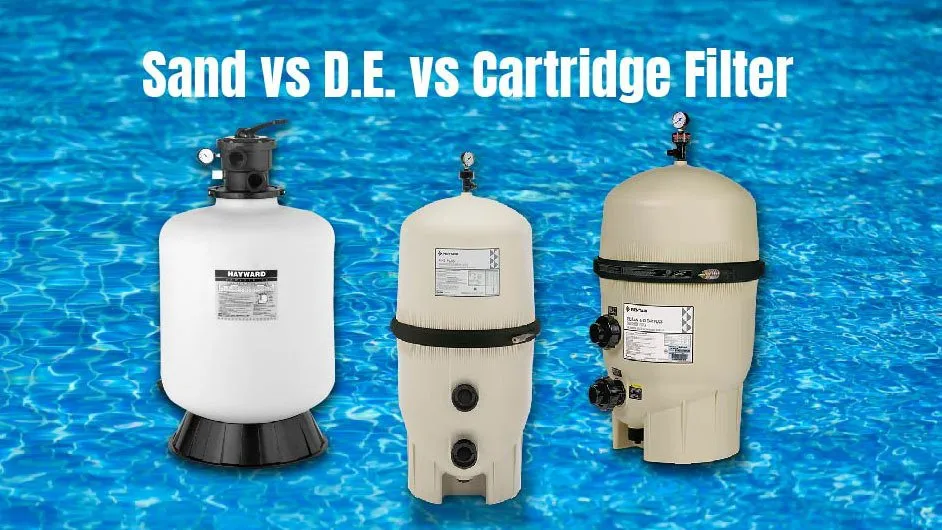
The Old Reliable: Sand Filters
Sand filters are the most common choice for residential pools, and for good reason. They are simple, affordable, and incredibly durable.
How They Work
Inside a large tank, water is pushed through a bed of special silica sand. As the water moves downward, the rough edges of the sand grains catch dirt and debris. Clean water flows out the bottom and back into your pool.
The Pros
- Low Maintenance: You don’t need to take anything apart to clean it. You simply “backwash” the system (run the water in reverse) to flush out the dirt.
- Durability: The sand itself lasts quite a while—typically 5 to 7 years before it needs replacing.
- Cost-Effective: This is generally the most budget-friendly option upfront.
The Cons
- Filtration Quality: Sand filters capture particles down to about 20–40 microns. That is small, but not microscopic. Water might look clean, but it won’t have that “polished” glass look.
- Water Waste: Backwashing requires dumping a significant amount of water (and the chemicals in it) out of your pool.
Best For: Busy homeowners who want a “set it and forget it” solution and don’t mind sacrificing a tiny bit of water clarity for convenience.
The Eco-Friendly Middle Ground: Cartridge Filters
If you have looked at pool equipment recently, you have likely noticed cartridge filters gaining massive popularity. They strike a fantastic balance between ease of use and high performance, making them one of the top Eco-Friendly Pool Options.
How They Work
These units house large, pleated polyester cartridges—similar to the air filter in your car, but much bigger. Water flows through the pleats, which trap debris on the surface.
The Pros
- Better Clarity: Cartridge filters can trap debris as small as 10–15 microns. This is twice as effective as sand.
- No Backwashing: This is a huge plus. You don’t waste thousands of gallons of heated, chemically treated water.
- Energy Efficient: They often operate at lower pressure than sand filters, which allows for Energy Efficient Operation and puts less strain on your pool pump.
The Cons
- Manual Cleaning: When the pressure gauge rises, you must open the tank, pull out the cartridges, and spray them down with a garden hose. It can be a wet and messy job.
- Replacement Costs: The cartridges typically last 2 to 4 years and can be pricier to replace than a bag of sand.
Best For: Homeowners who want clearer water and hate the idea of wasting water through backwashing.
The High-Performance Polisher: D.E. Filters
If you are a perfectionist who demands water that sparkles like a diamond, Diatomaceous Earth (D.E.) is the gold standard.
How They Work
These filters use grids coated in a white powder made from fossilized diatoms (microscopic aquatic organisms). This powder is incredibly fine and acts as a microscopic sieve.
The Pros
- Superior Filtration: D.E. filters can trap particles as small as 1–3 microns. This is fine enough to remove some bacteria and even the finest dust.
- Unmatched Clarity: The water quality is noticeably different—it truly shines.
The Cons
- High Maintenance: Like sand filters, they require backwashing. However, after backwashing, you must add fresh D.E. powder to the system.
- Complex Cleaning: At least once a year, the filter needs to be fully disassembled to maintain properly.
- Cost: These are typically the most expensive units to buy and maintain.
Best For: Pool enthusiasts who want the absolute best swimming pool filter performance available and don’t mind a little extra work to get it.
Comparison at a Glance
Here is how the three stack up against each other.
| Feature | Sand Filter | Cartridge Filter | D.E. Filter |
| Filtration Size | 20–40 microns (Good) | 10–15 microns (Better) | 1–3 microns (Best) |
| Maintenance | Backwash (Easy) | Rinse Cartridges (Moderate) | Backwash + Add Powder (High) |
| Water Usage | High (Wastes water) | Low (Eco-friendly) | High (Wastes water) |
| Upfront Cost | $ | $$ | $$$ |
Which One Is Right for Your PA Home?
Living in Pennsylvania means dealing with specific environmental factors—pollen in the spring, humid summers, and falling leaves in autumn.
If your backyard has heavy tree coverage, a Sand Filter might be your best bet simply because it handles large debris loads easily without clogging as quickly.
However, if you are looking for the best swimming pool filter to keep your water shimmering for those July 4th parties, and you want to save on your water bill, we often recommend Cartridge Filters to our clients. They offer a perfect mix of performance and sustainability.
Ready to Upgrade Your Pool Experience?
Choosing the right filter is the first step toward a hassle-free summer. Whether you need a simple replacement or a full equipment upgrade, it is important to get professional advice tailored to your specific pool size and usage.
At Poseidon’s Custom Pools, we have been helping homeowners in Pennsylvania create and maintain their dream backyards for years. We know what works best in our local climate.
Would you like me to help you draft a specific email inquiry to send to Poseidon’s Custom Pools to get a quote on a new filter installation?