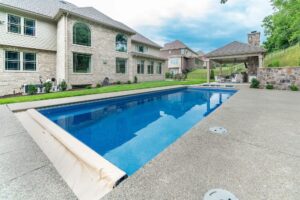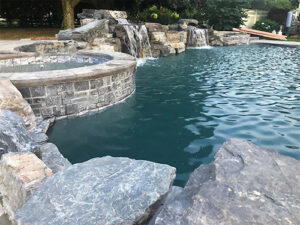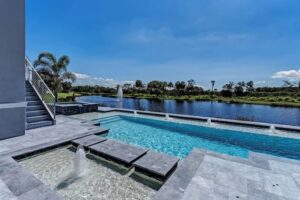
A backyard pool is one of the largest single improvements most homeowners will ever make to their property, and it is also one of the few where the quality of the crew matters more than the quality of the product catalog. Searching for inground pool builders central Pennsylvania returns dozens of companies, but the differences between them are rarely visible on a homepage.
This guide gives you the vetting framework professional buyers use. You will learn how to confirm a contractor is properly registered in Pennsylvania, how concrete and vinyl liner construction actually differ once the shell is in the ground, what the build sequence looks like from excavation to first fill, and the specific hiring mistakes that turn a straightforward project into a two-season headache.
The goal is simple. By the end, you should be able to sit across from any pool contractor in the region and know within twenty minutes whether they are the right fit.
Key Takeaways
- Verify a builder’s Home Improvement Contractor registration before signing anything with a builder.
- Central Pennsylvania’s freeze-thaw cycles make winterization planning part of the build, not an afterthought.
- The best inground pool builders in Central Pennsylvania quote in writing with a defined scope.
- Concrete and vinyl liner pools serve different budgets, timelines, and long-term maintenance patterns.
- Municipal permits and barrier requirements vary town to town, so local experience genuinely matters.
- A low bid that excludes excavation, electrical, or backfill is not actually a low bid.
What “Central Pennsylvania” Means for Your Build
Central Pennsylvania is a region rather than a municipality, which has practical consequences for your project. A builder serving Harrisburg, Lancaster, York, Hershey, Camp Hill, Mechanicsburg, Carlisle, and Lebanon is working across multiple townships and boroughs, each with its own permitting office and inspection schedule.
That matters because pool permits are issued locally. Two homes twenty minutes apart can face different setback rules, different barrier requirements, and different review timelines. Local pool installation experts earn their value in the permitting phase, long before a shovel touches the ground.
The region’s climate adds a second layer. Central Pennsylvania sees genuine freeze-thaw cycling, meaning water that penetrates plumbing lines or the shell structure expands as it freezes. A builder who works in the region year after year designs for this. One who does not may leave you with cracked returns after a single hard winter.
Soil conditions vary considerably as well. Parts of the region sit on limestone and shale, which affects excavation cost and sometimes requires engineering adjustments. If a builder quotes you a firm price without seeing the property, treat that number as a marketing figure rather than a bid.
Concrete vs. Vinyl Liner: An Honest Comparison
Most residential pool installation services in the region center on two construction methods. Neither is universally better. They solve different problems.
| Factor | Concrete (Gunite/Shotcrete) | Vinyl Liner |
|---|---|---|
| Design flexibility | Fully custom shape, depth, and features | Wide range of shapes, some panel constraints |
| Typical build window | Longer, multi-stage curing required | Shorter, faster to water |
| Upfront cost | Higher | Lower |
| Surface feel | Firm, textured finish | Smooth, softer underfoot |
| Long-term upkeep | Periodic resurfacing over decades | Liner replacement on a recurring cycle |
| Structural lifespan | Very long with proper maintenance | Long, with liner treated as a wear item |
| Best suited to | Custom geometry, tanning ledges, integrated spas | Value-focused builds and faster timelines |
If you want a fully custom shape with an integrated spa or vanishing edge, choose concrete. The forming process supports geometry that panel systems cannot match.
If your priority is getting swimming in the shortest realistic timeline within a defined budget, a vinyl liner build is usually the stronger option. The tradeoff is planning for liner replacement as a predictable future expense rather than a surprise. For a deeper dive into comparing concrete and vinyl liner construction methods, explore our detailed materials guide.
A good builder will walk you through both rather than steering you toward whichever one their crew prefers. If a contractor dismisses one method entirely without asking about your budget or backyard, that tells you something.
7 Mistakes to Avoid When Hiring Pool Contractors
These are the errors that show up repeatedly in consumer complaints and contractor disputes. For an expanded breakdown with prevention strategies, see our full guide on the seven mistakes that cost homeowners the most money.
- Skipping the registration check. Pennsylvania’s Home Improvement Consumer Protection Act requires most contractors performing home improvement work above a set annual threshold to register with the Pennsylvania Office of Attorney General. Licensed pool builders Pennsylvania homeowners can trust will provide that registration number without hesitation. You can confirm status directly through the Pennsylvania Attorney General’s HIC registration lookup.
- Accepting a verbal scope. If decking, backfill, electrical bonding, or landscape restoration is not written into the contract, assume it is not included.
- Paying a large deposit up front. Pennsylvania law places limits on advance payments for home improvement contracts. A builder demanding most of the project cost before mobilization is a serious warning sign.
- Comparing bids on price alone. One quote may include the concrete deck, safety cover, and electrical. Another may not. Normalize the scope before you compare numbers.
- Ignoring the subcontractor question. Ask who performs excavation, plumbing, electrical, and finish work. If everything is subbed out to rotating crews, scheduling reliability tends to suffer.
- Not reading pool builder reviews carefully. Look for reviews that describe the build process and post-installation support, not just the finished photo. Patterns matter more than individual ratings.
- Building without a service plan. Ask who opens, closes, and services the pool after the first season. Some professional pool contractors offer ongoing service; others hand you off entirely.
How to Hire an Inground Pool Builder: Step by Step
Step 1: Build a shortlist of three to four companies.
Search inground pool companies near me, then filter to those with an established presence in your specific county. Regional experience beats a slick website.
Step 2: Verify registration and insurance.
Request the Pennsylvania Home Improvement Contractor registration number and current certificates for general liability and workers’ compensation. Confirm coverage directly with the insurer, not just the PDF.
Step 3: Schedule on-site consultations.
No credible quote for custom inground pool construction happens over the phone. The builder needs to assess grade, access for excavation equipment, utility locations, and drainage. When you’re ready, schedule your on-site consultation to get started.
Step 4: Request itemized written proposals.
Every proposal should separate shell construction, excavation and spoil removal, plumbing, electrical and bonding, filtration equipment, decking, and site restoration. Use our list of key questions to ask during your proposal review to ensure nothing is overlooked.
Step 5: Review three recent local references.
Ask specifically for projects completed in the last two seasons within your area. Then ask those homeowners one question: did the schedule hold?
Step 6: Confirm the permit responsibility in writing.
The contract should state who pulls municipal permits and who schedules inspections. Ambiguity here causes delays. For specifics on local pool permitting and barrier requirements, consult our dedicated permitting guide.
Step 7: Review the contract before signing.
Confirm the payment schedule ties to construction milestones, the warranty terms for both workmanship and equipment, and the process for handling change orders.
Step 8: Establish a communication cadence.
Agree on who your point of contact is and how often you will receive updates. This single step prevents most project frustration.
Pros and Cons of Hiring a Local Central PA Builder
Pros
- Established relationships with township permitting offices speed up approvals.
- Crews understand regional soil, drainage, and freeze-thaw requirements.
- Warranty service and seasonal support are realistically accessible.
- Local reputation creates accountability that a distant company does not carry.
- Site visits and punch-list corrections happen faster.
Cons
- Smaller local firms may have limited build slots per season.
- Peak-season scheduling often requires booking months ahead.
- A very small operation may have less depth if a key crew member is unavailable.
- Design portfolios can be narrower than those of large multi-state firms.
If your project involves complex engineering on a difficult grade, choose a builder with in-house excavation and a documented history of similar sites. Subcontracting that phase adds coordination risk exactly where you can least afford it.
Do and Don’t Checklist
Do
- Do get every promise in the written contract.
- Do ask to visit an active job site to see crew standards firsthand.
- Do confirm your homeowner’s insurance carrier before construction begins.
- Do plan your barrier, fencing, and gate hardware early in the design phase. Refer to the CPSC residential pool safety guidelines for federal barrier standards.
- Do ask what happens if the project runs past the estimated completion date.
Don’t
- Don’t pay cash without a receipt tied to a contract milestone.
- Don’t allow work to begin before permits are issued.
- Don’t assume landscaping restoration is included.
- Don’t sign a contract with an open-ended completion window.
- Don’t choose based on the lowest bid without normalizing scope.
A Real-World Scenario
A homeowner outside Mechanicsburg collected three bids for a custom inground pool. Two quotes landed within a few thousand dollars of each other. The third came in noticeably lower, which made it tempting.
On closer reading, the low bid excluded spoil removal, the concrete deck, and electrical bonding. It also listed a completion window as “spring” with no defined end date. When the homeowner asked the contractor to itemize those exclusions, the revised total exceeded both competing bids.
They selected the mid-priced builder, whose contract tied payments to five construction milestones and named the township permit process explicitly. The project finished within the stated window. The lesson is not that cheap bids are always bad. It is that incomplete bids are not comparable to complete ones.
Permits, Codes, and Safety Requirements
Residential pool construction in Pennsylvania falls under the state’s Uniform Construction Code, administered through the Department of Labor and Industry and enforced by local municipalities. Your township or borough issues the permit and performs inspections.
Barrier requirements are the most commonly overlooked element. Most jurisdictions require a compliant fence or barrier with self-closing, self-latching gates around the pool area. Confirm the exact specification with your municipality before the deck is poured, since retrofitting is far more expensive. The Pool & Hot Tub Alliance industry standards provide additional guidance on compliant construction and safety best practices.
Electrical bonding is not optional. All metallic components near the pool must be bonded to prevent electrical hazards, and this work requires inspection. Any builder who treats bonding casually should be removed from your shortlist immediately.
The Pool and Hot Tub Alliance publishes industry standards and professional certification programs, and asking whether a builder holds any certification through them is a reasonable question. The Better Business Bureau is a useful secondary check for complaint history.
Quick Answers: Frequently Asked Questions
How long does inground pool construction take in Central Pennsylvania?
A: Most residential builds run several weeks to a few months from excavation to fill, depending on construction method, weather, and inspection scheduling. Concrete pools require curing time that vinyl liner builds do not. For a detailed phase-by-phase breakdown, see our guide on how long inground pool construction typically takes.
When should I book a pool builder for a summer swim season?
A: Contact builders in late fall or winter for the following summer. The best inground pool contractors PA homeowners want typically fill their spring and early summer slots months in advance.
Do pool contractors in Pennsylvania need to be registered?
A: Most contractors performing home improvement work above a defined annual threshold must register with the Pennsylvania Office of Attorney General under the Home Improvement Consumer Protection Act. Always request the registration number.
Who pulls the permit, me or the builder?
A: This should be stated explicitly in your contract. Experienced local builders usually handle municipal permitting as part of their scope, but never assume it.
Can a pool be built on a sloped lot?
A: Yes, though sloped sites often require retaining walls, additional engineering, or modified excavation. Expect this to affect both cost and timeline.
What should be included in a written pool proposal?
A: Shell construction, excavation and spoil removal, plumbing, electrical and bonding, filtration equipment, decking, permits, site restoration, warranty terms, and a milestone-based payment schedule.
How much deposit is normal?
A: Pennsylvania law limits advance payments on home improvement contracts. A reasonable deposit ties to mobilization, with remaining payments released at defined construction stages.
Does a pool add value to a Pennsylvania home?
A: Effects on resale value vary widely by neighborhood, lot size, and buyer demand. Industry experts generally suggest treating a pool as a lifestyle investment first and a value addition second. For comprehensive pricing context, review our guide on swimming pool installation costs in Pennsylvania.
What maintenance should I plan for in a freeze-thaw climate?
A: Proper winterization each fall, including line blowout and appropriate water level management, plus a spring opening. Many homeowners contract this seasonally.
Glossary of Terms
Gunite / Shotcrete
A concrete mixture sprayed at high pressure over a steel rebar framework to form the pool shell. It allows fully custom shapes and depths.
Bonding Grid
An interconnected network of conductive components around the pool tied to a common electrical point. It equalizes electrical potential and is a required safety measure.
Skimmer
The intake opening at the waterline that draws surface water into the filtration system. It captures leaves and debris before they sink.
Change Order
A written amendment to the original contract documenting a scope change and its cost impact. Every change should be documented before work proceeds.
Conclusion
Choosing among inground pool builders in Central Pennsylvania is less about finding the company with the best photos and more about finding the one whose paperwork, process, and local knowledge hold up under questioning. Verify registration and insurance. Insist on an itemized written scope. Tie payments to construction milestones. Confirm who pulls permits.
The region’s freeze-thaw climate and township-by-township permitting rules reward builders with genuine local experience, and they punish homeowners who skip the vetting steps. A few hours of due diligence up front consistently prevents the disputes that drag projects into a second season.
Ready to move forward? Schedule your on-site consultation and request an itemized written proposal, then use the checklist in this guide to evaluate what comes back. A builder who welcomes those questions is usually the one worth hiring.