That first glance at your new, shimmering pool is a feeling unlike any other. It’s a backyard oasis, a place for family fun, and the centerpiece of your home. Then comes the first water test. Suddenly, you’re looking at a list of terms like “pH,” “alkalinity,” and “cyanuric acid,” and that dream starts to feel a bit like a high school chemistry class you forgot to study for.
This is a feeling every new pool owner has. The good news? It’s far less complicated than it looks.
Balancing pool chemicals is the single most important skill you will learn. It is the secret to protecting your new pool investment and ensuring the water is always safe, clear, and comfortable. This guide is designed to be your go-to resource. We’ll cut through the jargon and give you a simple, step-by-step process.
Why Bother? The Real Impact of Unbalanced Water
Before we dive into the “how,” let’s cover the “why.” You might be tempted to just toss in a chlorine tablet and hope for the best. This approach, however, can lead to costly problems.
- It Protects Your Swimmers: Water that is out of balance can cause skin irritation, red eyes, and ear infections. Properly sanitized water is safe for the whole family.
- It Protects Your Investment: This is the big one. Acidic water (low pH) will corrode everything it touches—your pool pump, heater, ladders, and even the surface of your new gunite pool. Basic water (high pH) causes scaling, leaving ugly white deposits and clogging your filter system.
- It Keeps Water Clear and Inviting: Nobody wants to swim in a cloudy or green pool. Proper balance is what creates that sparkling, “jump-in-right-now” look.
- It Saves You Money: Balanced water allows your sanitizer (chlorine) to work efficiently. Unbalanced water requires more chemicals to do the same
job, costing you more time and money.
Your Essential Pool Chemistry Toolkit
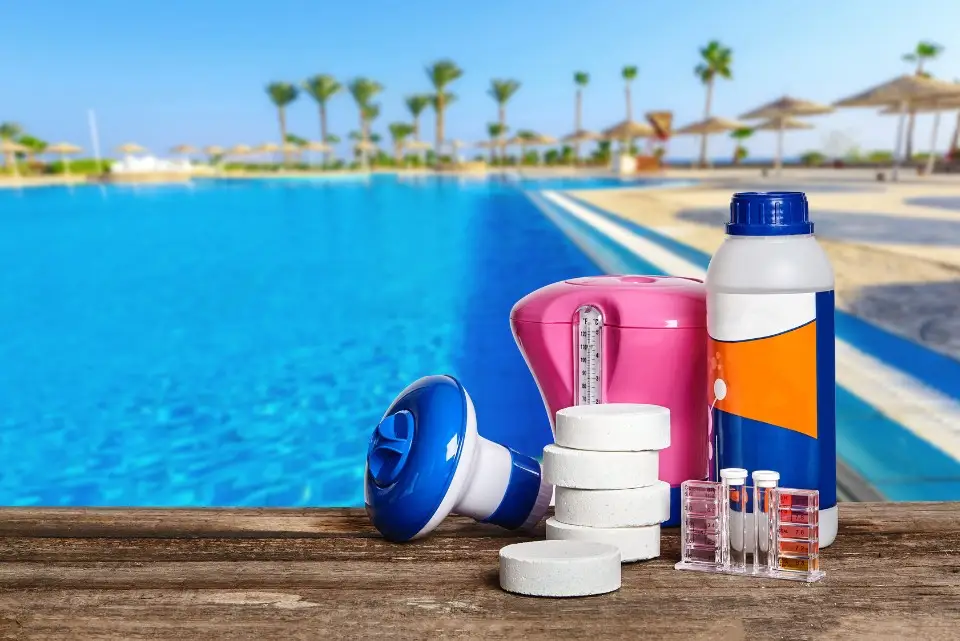
You don’t need a full laboratory, but you do need a few key items. Think of this as your pool’s maintenance kit.
- A Reliable Test Kit: This is non-negotiable. You cannot balance what you cannot measure.
- Test Strips: These are fast and easy. You dip a strip, and compare the colors to a chart on the bottle. They are great for quick daily checks.
- Liquid Reagent Kits: These are the gold standard for accuracy. You take a water sample and add specific drops (reagents) to see the color change. We recommend a good liquid kit for your main weekly test.
- The Core Chemicals: Don’t be intimidated by the names. You’ll get to know them quickly. You’ll need sanitizers (like chlorine), pH adjusters (pH Up and pH Down), alkalinity increaser, and calcium hardness increaser.
The “Big Five”: Understanding Pool Chemistry
Your test kit will measure several things, but these are the five pillars of water balance.
1. Sanitizer (Chlorine)
- What it is: This is the germ killer. It neutralizes bacteria, viruses, and algae.
- Why it matters: It’s your first line of defense against germs.
- Ideal Range: 1.0 – 3.0 parts per million (ppm).
2. pH (Potential Hydrogen)
- What it is: A measurement of how acidic or basic your water is. The scale runs from 0 (very acidic) to 14 (very basic), with 7.0 being neutral.
- Why it matters: This is the most critical factor. If your pH is off, nothing else works correctly. High pH makes chlorine lazy and ineffective. Low pH is corrosive.
- Ideal Range: 7.4 – 7.6 (This is a narrow, important window based on industry-accepted ranges).
3. Total Alkalinity (TA)
- What it is: This is your pH’s bodyguard. It’s a measure of dissolved particles that “buffer” or stabilize the pH.
- Why it matters: If your TA is low, your pH will swing wildly every time it rains or you add chemicals. If it’s too high, your pH will be “locked” and very difficult to change.
- Ideal Range: 80 – 120 ppm.
4. Calcium Hardness (CH)
- What it is: The amount of dissolved calcium in your water.
- Why it matters: Especially important for concrete and gunite pools (like ours!). Water wants calcium. If it doesn’t have enough (soft water), it will take it from your pool’s plaster or gunite surface, causing etching and damage. If it has too much (hard water), it will deposit it as scale.
- Ideal Range: 200 – 400 ppm.
5. Stabilizer (Cyanuric Acid or CYA)
- What it is: Think of this as sunscreen for your chlorine.
- Why it matters: In an outdoor pool, the sun’s UV rays destroy chlorine. CYA forms a weak bond with chlorine, protecting it from the sun so it lasts longer. Without it, you could lose your entire day’s chlorine in just a few hours.
- Ideal Range: 30 – 50 ppm.
Pool Chemical Quick-Reference Guide
| Chemical Factor | Ideal Range | What it Does | Common Fix (If Low) | Common Fix (If High) |
| Sanitizer (Chlorine) | 1.0 – 3.0 ppm | Kills germs & algae. | Add chlorine (tablets, liquid, or shock). | Stop adding chlorine; wait for sun to lower it. |
| pH | 7.4 – 7.6 | Measures acidity/basicity. | Add “pH Up” (Soda Ash). | Add “pH Down” (Muriatic Acid or Dry Acid). |
| Total Alkalinity | 80 – 120 ppm | Stabilizes and buffers pH. | Add “Alkalinity Increaser” (Sodium Bicarbonate). | Use Muriatic Acid (lowers both pH & TA), then raise pH. |
| Calcium Hardness | 200 – 400 ppm | Protects surfaces from corrosion. | Add “Calcium Hardness Increaser.” | Partially drain and refill with fresh, softer water. |
| Stabilizer (CYA) | 30 – 50 ppm | Protects chlorine from sun. | Add “Stabilizer” or “Conditioner.” | Partially drain and refill water (CYA does not evaporate). |
A Step-by-Step New Pool Owner Guide to Balancing
Here is the secret: you must adjust chemicals in a specific order. Always follow this process, and you will save yourself a lot of frustration.
The Golden Rule: Always adjust Total Alkalinity first, then pH, and then your Sanitizer.
Step 1: Test Your Water
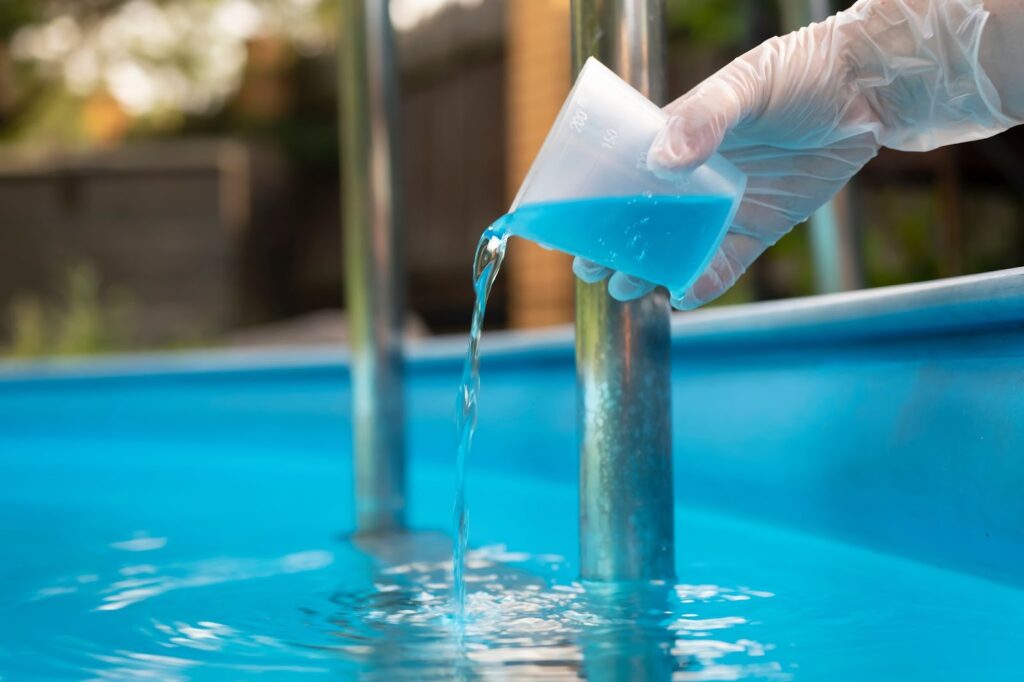
Take a water sample from about 18 inches below the surface (elbow deep), away from any jets or skimmers. Use your test kit to get a baseline reading for all five key levels.
Step 2: Adjust Total Alkalinity (TA)
Your TA is the foundation. Get this right first.
- If your TA is low (below 80 ppm), add an Alkalinity Increaser (sodium bicarbonate).
- If your TA is high (above 120 ppm), this is trickier. Adding Muriatic Acid will lower both TA and pH. You may need to add it, let the water circulate, and then add “pH Up” to bring the pH back into range.
- Pro Tip: Always add chemicals to a bucket of pool water first to dissolve them, and follow safe handling practices. Never add chemicals directly into the skimmer.
Step 3: Adjust Your pH
Wait at least 4-6 hours after adjusting TA, then re-test your pH.
- If your pH is low (below 7.4), add “pH Up” (soda ash).
- If your pH is high (above 7.6), add “pH Down” (muriatic acid or sodium bisulfate).
- Circulate the water and test again in a few hours.
Step 4: Adjust Your Sanitizer (Chlorine)
Once your TA and pH are balanced, your chlorine will be effective. Now you can adjust it.
- If chlorine is low, this is the time to “shock” the pool (more on this below) or add your regular tablets/liquid chlorine.
- The goal is to maintain a consistent 1.0-3.0 ppm.
Step 5: Adjust Calcium and Stabilizer
These levels don’t change quickly, so you typically only need to adjust them a few times a season. Adjust them last.
- Add Calcium Hardness Increaser if low.
- Add Stabilizer (CYA) if low, usually during your spring opening.
Balancing Pool Chemicals for the Pennsylvania Season
As a homeowner in Pennsylvania, your pool care is different from someone in Florida. Our distinct seasons change the game.
Spring Opening (The Big Balance):
When you first open your pool, the water chemistry will be all over the place. This is when you’ll follow the step-by-step guide above most carefully. You will likely need to shock the pool heavily to clear out everything that grew over the winter, and then rebuild your chemical levels from the ground up. This is also when you’ll add your stabilizer (CYA) for the season.
Summer Maintenance:
Heat and sun are your biggest enemies.
- After a Heat Wave: Hotter water needs more chlorine. Test more frequently.
- After a Big Rainstorm: Rain is acidic and will dilute your chemicals. A heavy PA thunderstorm will almost always lower your pH and TA. Always test your water after it rains.
- After a Pool Party: A lot of swimmers (and their sunscreen, sweat, etc.) use up chlorine fast. It’s a smart practice to “shock” your pool that evening to burn off all the waste and restore a healthy chlorine level.
Fall Closing:
Don’t just throw a cover on it! Proper seasonal pool care and winterization is vital. You’ll want to add a winterizing chemical kit and adjust your levels to be slightly on the high side. This helps protect your pool surfaces during the long winter and makes your spring opening much, much easier.
Common Problems and Quick Fixes
- Problem: Cloudy Water.
- Cause: Usually this is a filtration issue or very high pH (making chlorine ineffective).
- Fix: Check your filter and clean it. Then, test and balance your pH and TA. Shock the pool at night and run the filter 24/7 until it clears.
- Problem: Strong “Chlorine” Smell & Red Eyes.
- Cause: This is ironic—it’s not caused by too much chlorine, but by not enough free chlorine. The smell is from “chloramines,” which are byproducts of chlorine killing germs.
- Fix: You need to “shock” (or super-chlorinate) the pool. This means adding a large dose of chlorine to break down the chloramines and “free up” the chlorine to work again.
- Problem: Green Water (Algae).
- Cause: Low or no chlorine, often combined with high pH.
- Fix: Act fast. Balance your pH first. Then, brush the pool walls and floor. Shock the pool heavily with a chlorine-based shock and add an algaecide. Run your filter continuously until the water is clear.
Your Pool is for Joy, Not Stress
As a new pool owner, this can all seem overwhelming. But after a few weeks, it will become a simple, 10-minute routine.
At Poseidon’s Custom Pools, we believe your backyard should be a place of relaxation. While our passion is designing and building Pennsylvania’s most beautiful custom gunite pools, our expertise doesn’t stop when the construction is finished. We want you to enjoy that investment for decades to come, and that all starts with good, clean water.
You’ve got this. Take it one step at a time, test regularly, and remember the “why” behind it. A few minutes of maintenance each week is all it takes to guarantee a whole season of crystal-clear memories.
What’s your biggest question about balancing pool chemicals? Ask us in the comments below! We’re happy to help our fellow pool owners.